AI solutions built from our research
We turn our research into solutions that companies can use or build on. They are listed here by the areas of our research.
Two systems are already built. One library is available now and one is announced. More systems, libraries and applications will follow.
Energy, 3 solutions
AI systemStage: Built, in testing on real data
brillQ AgroFlex
Hybrid digital layer for multi-site agricultural energy systems
Energy flexibility for farms with biogas, solar and storage, kept within animal welfare and digester limits.
Key features
- Indoor climate forecastingPredicts temperature, humidity, CO2 and ammonia in livestock houses, and the flexibility left.
- Safe digester feedingEstimates free ammonia and a tolerance threshold, so combined heat and power runs safely.
- Robust dispatch planningSchedules PV, storage, CHP and shiftable loads 24 to 48 hours ahead in 15-minute steps.
- AI agents under human approvalAgents keep the models up to date, with no access to setpoints and an audit log.
- Independent safety supervisorChecks every plan against raw sensor data and switches to a safe mode when needed.
Problems it solves and how it works: brillQ AgroFlex
The problems it answers
- Your farm sites hold flexible energy, but using it could harm animal welfare or upset the digester.
- You cannot tell how much real flexibility a livestock house has once indoor conditions must be recovered.
- Feeding the digester to suit energy needs risks free ammonia inhibiting the microbial process.
- With many sites and AI models, you need to know who checks them, who approves changes and what the audit trail shows.
What you get
- The climate models are designed to predict indoor temperature, humidity, CO2 and ammonia, and the net flexibility left after indoor conditions recover.
- Digester feeding is planned from an estimate of free ammonia and a tolerance threshold, for safe scheduling of combined heat and power units.
- PV, battery storage, CHP and shiftable loads are planned 24 to 48 hours ahead in 15-minute steps.
- The plan comes from an optimizer kept separate from machine learning, so it does not depend on a learned model.
- AI agents maintain the models without write access to setpoints or welfare limits, with an append-only log and human approval of every deployment.
How it works
The system is already built, not only designed, and is in testing on real data at a client site: a five-layer digital layer for farms that combine livestock housing, anaerobic digesters with combined heat and power, photovoltaics and battery storage, where energy flexibility is bounded by animal welfare and by the microbial process in the digester.
- Climate models that predict indoor temperature, humidity, CO2 and ammonia in livestock houses, and the net energy flexibility after recovering indoor conditions.
- Predictive feeding of anaerobic digesters that estimates free ammonia and a time-varying tolerance threshold, for safe scheduling of combined heat and power units.
- Robust optimization that schedules PV, battery storage, CHP and shiftable loads over a horizon of 24 to 48 hours in 15-minute steps, kept separate from machine learning.
- Seven language model agents for model lifecycle, drift detection and retraining, with no write access to setpoints or welfare limits, an append-only audit log and human approval of every model deployment.
- An independent supervisory module that checks every dispatch plan against raw sensor data and switches to a safe mode when sensor credibility falls or welfare limits come close.
How a project with us runs
- Step 1: We start from your sites: livestock housing, digesters with CHP, photovoltaics and battery storage, and the welfare and process limits that bound them.
- Step 2: Acceptance criteria for every component are fixed before data collection, with an explicit baseline for each forecast.
- Step 3: The models are tested on real data, as the system is now in testing on real data at a client site.
- Step 4: Agents keep models current and log their actions, and a person approves each model before it goes live.
AI systemStage: Built, in testing on client data
brillQ Thesis
AI-driven energy management system with independent execution safety
AI energy management for battery storage, solar and flexible loads, with an independent guardian that checks every command.
Key features
- Calibrated forecastsForecasts arrive as probability distributions, and the decisions use them.
- AI that decides, never touches hardwareAn agent plans the operation; a separate layer executes it.
- Independent execution guardianEvery command is checked before it runs, with a pre-verified fallback.
- Value and provenance monitoringTracks the value the agent adds and holds output from untrusted sources.
- Staged path to autonomyFrom simulation through shadow and advisory modes to supervised autonomy.
Problems it solves and how it works: brillQ Thesis
The problems it answers
- You want AI to optimize battery storage, solar and flexible loads, with the agent kept away from your hardware.
- A battery state estimate that drifts, or a falsified measurement, can mislead a safety check that trusts the same data.
- A simple before-and-after comparison can report the agent's value with the wrong sign, so you cannot trust the claimed savings.
- A tampered tariff or a hidden instruction in an email could push a wrong command toward your assets.
What you get
- Three layers with separate authority: forecasts describe, an agent decides, and a separate layer executes and guards.
- Forecasts arrive as calibrated probability distributions, and the decisions demonstrably use them.
- An independent guardian checks every command before it runs, with a pre-verified fallback.
- Monitoring tracks the value the agent adds, and a provenance check holds every output from an untrusted source, such as a tampered tariff.
- You gain autonomy step by step, from simulation through shadow and advisory modes to supervised autonomy.
How it works
The system is built and is in testing on a client's data: an AI-driven energy management system for battery storage, photovoltaics and flexible loads, with three layers of non-overlapping authority, in which an agent decides but never touches hardware and an independent guardian in the execution layer checks every command. It is built on two of our technical reports: the reference architecture and its tests on real data.
- A predictive layer that forecasts and describes but never decides; its forecasts arrive as calibrated probability distributions, and the decisions use them.
- An agentic decision layer that decides but never touches hardware.
- A platform and execution layer that executes and guards but never chooses what to execute, except through a pre-verified fallback, with an independent guardian whose independence covers code, data, models and authority, and extends to sensors through diverse measurements and cross-checks.
- Monitoring of the value the agent adds, with thresholds set for each site on a year of data, and a provenance check that holds every output from an untrusted source, such as a tampered tariff.
- A staged path from simulation through shadow and advisory modes to supervised autonomy, with a shadow-mode protocol for a real site.
How a project with us runs
- Step 1: Simulation comes first: the three layers and the contracts between them are specified, and the agent and guardian are tested in simulation.
- Step 2: Shadow mode follows, using the shadow-mode protocol the report specifies for a real site.
- Step 3: Advisory mode follows, as the next stage of the staged path.
- Step 4: Supervised autonomy comes last, with the independent guardian and value monitoring running, with thresholds set on a year of data from your site.
Results from our research
Every charge-limit breach stopped when the state estimate drifted, for 0.09% of cost
Conditions: Simulation, 41 synthetic sites
9.8 to 10.9% lower energy cost than rules that barely use the battery, before wear
Conditions: Replayed on public data, simulated battery
Monitoring caught 240 of 240 simulated attacks
Conditions: Simulated attacks on recorded data; one hidden email instruction was still obeyed by the language model and let through by the checks
LibraryStatus: Announced
brillQ Arbiter
Share one grid connection between wind, solar and storage owners, with the limits of the agreement enforced automatically.
Key features
- Deterministic arbiterEnforces the limits of the connection agreement at its core.
- Shared grid connectionsOne connection shared by wind, PV and battery owners, also called cable pooling.
- Deployment by brillQIntegration with plant controllers, meters and operator protocols at your site.
- Free and full versionsA very limited free version under the MIT license, the full version under a commercial license.
Problems it solves and how it works: brillQ Arbiter
The problems it answers
- Exceeding the limit of your connection agreement can suspend the whole grid connection, so one mistake affects every owner.
- Wind, solar and battery owners share one connection, so how its band is shared must be agreed and set down.
- A flexible connection agreement ties admissible power to time, operator commands and measured network parameters.
- A planner that writes setpoints directly can break the limit when there is noise or an unannounced outage.
What you get
- A deterministic arbiter enforces the limits of the connection agreement at the core of the control loop.
- It supports cable pooling, with wind, PV and battery owners sharing one connection.
- brillQ carries out deployment at your site and integration with plant controllers, meters and operator protocols.
- brillQ also prepares you for the operator requirements and for certification.
- Besides the full commercial version, a free version with very limited functions will be open source under the MIT license.
How it works
Library for flexible connection agreements and shared grid connections, built on our Connection Arbiter report, with the deterministic arbiter at its core, which enforces the limits of the agreement on a connection shared by wind, PV and battery owners.
- Announced, under a commercial license; not published yet.
- Deployment at a site, integration with plant controllers, meters and operator protocols, and preparation for the operator requirements and for certification are carried out by brillQ.
How a project with us runs
- Step 1: The library is announced and not yet available, so we begin with a conversation about your connection agreement and how your assets share the connection.
- Step 2: brillQ integrates the arbiter with your plant controllers, meters and operator protocols at the site.
- Step 3: We prepare for the operator requirements and for certification, then deploy the full version under a commercial license.
Results from our research
Up to 95% more capacity on the same grid area, as non-firm connections
Conditions: Modeled on public Polish data, for a network area planned for 100 MW firm, at a curtailment of 1 to 5% of the available energy; a result of the report on the agreements, not of the arbiter alone
From up to 57 MW over the limit to a 0.5 MW margin
Conditions: Four-hour simulations with noise, asset lags and outages; up to 57 MW is for a non-deterministic planner writing setpoints directly; the 0.5 MW margin does not hold in the seconds after an unannounced outage
Keywords: flexible connection agreement, cable pooling, deterministic arbiter, battery energy storage, hybrid power plant, open source free version, MIT license
Construction & buildings
Solutions in this area will be announced here at the beginning of 2027.
Health & medicine
Solutions in this area will be announced here at the beginning of 2027.
Space & aerospace
Solutions in this area will be announced here at the beginning of 2027.
Defense
Solutions in this area will be announced here at the beginning of 2027.
Robotics & autonomous systems
Solutions in this area will be announced here at the beginning of 2027.
AI & advanced computing, 1 solution
Python libraryStatus: Available now
brillQ OPEX
See where operating costs can fall, unit by unit, with the uncertainty shown and savings reported only when the evidence holds.
Key features
- Bayesian cost frontierBenchmarks the operating costs of comparable units against an efficient frontier.
- Credible intervals for every unitEach result comes with its uncertainty, not a single number.
- Evidence gateA saving is reported only when the evidence supports it.
- Explainable cost driversShows what drives the costs of each unit.
- Client reportsReports in HTML and Excel, in English and Polish.
Talk to us about a licensepip install brillq-opex-benchmarkProblems it solves and how it works: brillQ OPEX
The problems it answers
- Your rankings of branches, plants or hospitals show a score but hide how uncertain each score is.
- You are told a unit is expensive but not why.
- A few erroneous records can distort a benchmark and hide real evidence of inefficiency.
- You need to know how far each unit's estimate can be trusted.
What you get
- Operating costs of comparable units are benchmarked against a Bayesian efficient frontier.
- Each unit gets a credible interval, not a single number, so you see how firm its result is.
- An evidence gate reports a saving only when the evidence supports it, which cuts false recommendations.
- Explainable cost drivers show what pushes up the costs of each unit.
- Client reports come in HTML and Excel, in English and Polish.
How it works
Bayesian cost-frontier benchmarking of operating costs (OPEX) for comparable units such as network areas, plants, branches and hospitals: credible intervals for every unit, an evidence gate before any saving is reported, explainable cost drivers and client reports in HTML and Excel, in English and Polish.
- The paper refers to this library as brillq-opex, an earlier name of the package.
How a project with us runs
- Step 1: You try the library in its evaluation mode, with all features, on your own data, within the limit of 30 units per analysis.
- Step 2: You review the first results, including the credible intervals and what the evidence gate allowed.
- Step 3: If the results are useful, you move to a commercial license for analyses of more than 30 units.
- Step 4: Reports in HTML and Excel go to your teams, with the cost drivers behind each unit.
Results from our research
95% ranges that hold on average: 96.0% against 54.6% for plug-in intervals
Conditions: Monte Carlo experiments, 8,930 model fits; for the least efficient tenth of units coverage is 76 to 85%, with 60 or more units and a signal-to-noise ratio of 1 or more
4% or less false recommendations when no inefficiency exists, against 27 to 62% without the gate
Conditions: Monte Carlo experiments, 8,930 model fits
4.1 to 10.7% of payroll at stake in 958 hospitals
Conditions: Real public data, 958 Japanese public hospitals, model estimate at a 0.9 efficiency target; the same procedure found no such evidence for 89 Finnish distribution operators
Keywords: OPEX benchmarking, stochastic frontier analysis, Bayesian cost frontier, cost efficiency, explainable AI, SHAP, anomaly detection, utilities, hospitals
Sample report
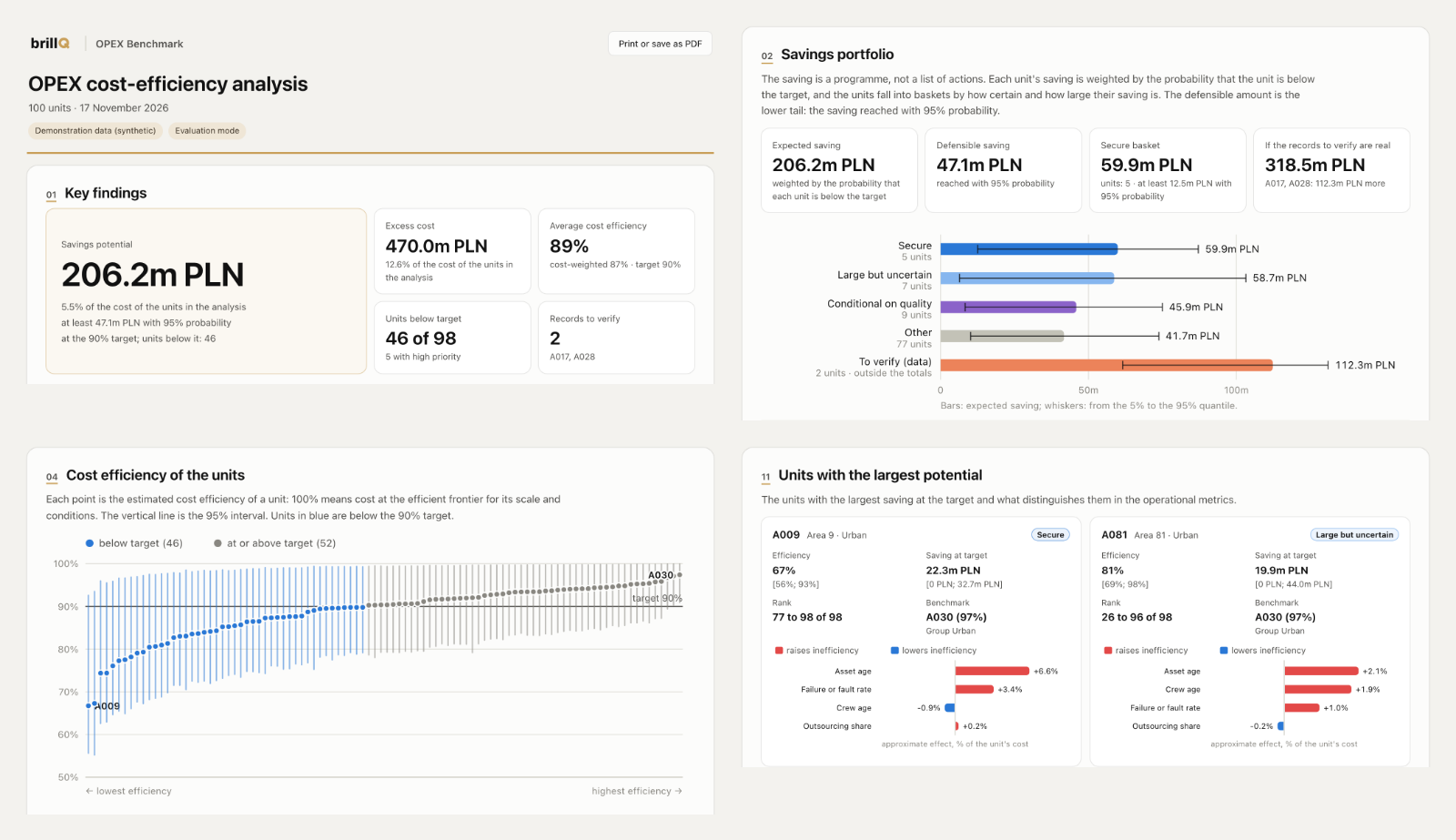
A report brillQ OPEX produced on synthetic demonstration data for 100 units, in evaluation mode. Its 16 sections run from the key findings and a savings portfolio weighted by probability to an action plan, data quality and the limits of the method. It opens in your browser, where it can be printed or saved as a PDF.
The papers behind these solutions and our patent applications are on the R&D page. If one of these solutions fits your problem, talk to us about a pilot.